Top Manhole Cover With Smart Lock Manufacturers
Choosing a Manhole Cover With Smart Lock manufacturer requires more than comparing product photos or feature lists. The cover must fit the chamber, withstand expected loads, and allow authorized crews to access underground assets reliably. A lock’s value depends on its materials, sealing, power system, and maintenance plan. Small details matter: a wet battery compartment or poorly matched frame can create problems later.
Engineering professor and author Henry Petroski expressed a useful principle: “Science is about knowing; engineering is about doing.” That broad engineering idea applies here. A manufacturer should be able to explain how its design performs in real installations, not only describe intended benefits. Ask for product specifications, test documentation, installation guidance, and clear information about emergency access. Evidence matters.
This outline examines leading manufacturers through practical criteria: locking technology, cover construction, environmental protection, compatibility, customization, and after-sales support. It also considers how companies document performance and help utilities manage keys, credentials, or access records. Compare claims carefully. A feature-rich system is not automatically the best choice for every site. Some installations need simple, durable controls; others may benefit from connected monitoring. There is no perfect shortlist without local requirements. That uncertainty deserves attention. The following sections offer a grounded way to assess the Manhole Cover With Smart Lock market and identify manufacturers whose capabilities match a project’s actual operating conditions.
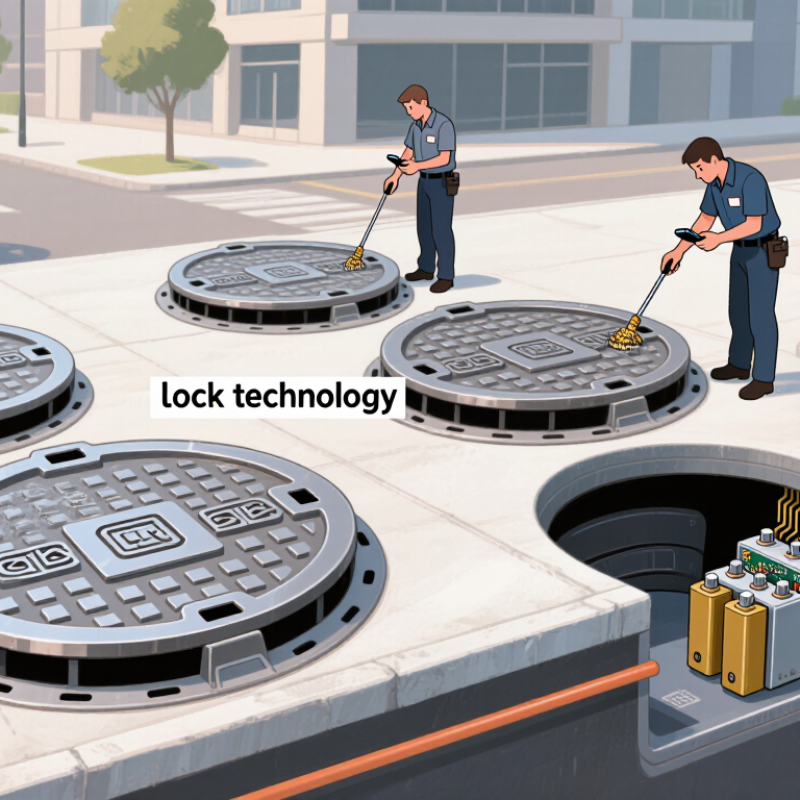
Smart-Lock Manhole Covers: Design, Components, and Applications
Smart-Lock Manhole Covers: Design, Components, and Applications
A smart-lock manhole cover combines a load-rated lid with a controlled locking assembly. Typical designs use a hardened latch, sealed electronic actuator, credential reader, position sensor, and replaceable power source. The frame must transfer traffic loads into the chamber, while seals and corrosion-resistant hardware protect electronics from water, grit, and de-icing salts. Small details matter. A loose sensor could report a closed lid even when the latch has not fully engaged. Not glamorous.
Access may use coded credentials, near-field communication, or remote commands, depending on connectivity and site risk. Utility teams can log openings and receive alerts when a cover shifts unexpectedly. Yet radio signals may fail below ground, and batteries need scheduled checks. A mechanical override is prudent. Poorly managed overrides, however, can weaken accountability.
Applications include water and wastewater networks, storm drains, telecom ducts, and transport infrastructure. The U.S. Environmental Protection Agency’s 2023 Drinking Water Infrastructure Needs Survey and Assessment estimated $625 billion in drinking-water investment over 20 years. The American Society of Civil Engineers’ 2021 Report Card graded wastewater infrastructure D+. These figures do not prove smart locks save money; they show why targeted asset protection deserves evaluation. Pilot installations should track false alarms, access time, corrosion, and maintenance labor. One awkward truth: added electronics can create another failure point. Choose them where access control addresses a measured operational problem.
Smart-Lock Manhole Covers: EN 124 Load Classes
Load-class test loads help match a cover to its installation environment. A smart lock adds access control; it does not change the cover’s load class.
Reference: EN 124 load-class designations and test loads. Select the class according to the site conditions and applicable local requirements.
EN 124 Load Classes: A15 (15 kN) to F900 (900 kN)
EN 124 load classes range from A15 at 15 kN to F900 at 900 kN. The figure refers to a standardised test load, not a simple vehicle-weight limit. A15 covers pedestrian and cyclist areas; B125 suits footways and comparable car parks. C250 is intended for kerbside channels, while D400 is common in carriageways and vehicle parking areas. The location matters.
E600 and F900 are designed for areas exposed to especially high wheel loads, such as industrial yards and aircraft pavements. Choosing a class by appearance alone is risky. Soil support, frame seating, traffic patterns, and installation quality affect real-world performance. A carefully fitted D400 cover may serve a road well; it is not automatically right for every site.
For smart-lock manhole covers, check that the lock, cover, and frame work as a tested assembly. The access system should not compromise the required load rating or safe maintenance. Ask for test documentation and installation guidance, then compare both with the site conditions. Small details count. Even a sound specification can fall short when the frame rocks or bears unevenly.
IEC 60529 IP Ratings: IP6X Dust-Tight and IPX8 Immersion Tests
For smart-lock manhole covers, an IP rating is useful only when it reflects the complete assembly. IEC 60529 defines protection against dust and water ingress. IP6X means the enclosure is dust-tight under the specified test. Small particles matter: grit around a lock bolt can increase friction or prevent smooth engagement. The rating does not prove resistance to corrosion, impact, or long-term wear.
IPX8 addresses immersion beyond the conditions associated with IPX7, but the test depth and duration are specified for the product. They should be stated in the test documentation. IPX8 alone does not tell a buyer how deep or how long a cover was tested. Nor does it automatically mean the lock can operate while submerged. Check whether the test assessed ingress only or also verified electronic functions afterward.
Test the cover in its intended configuration, including seals, cable entries, hinges, and lock components. A loose cable gland can undermine an otherwise sound enclosure. So can uneven gasket compression around a heavy lid. Manufacturers should record the sample setup, immersion conditions, and inspection results, then repeat checks after assembly changes. A passing sample is not a guarantee. Real installations may include worn seals, grit, and imperfect seating; those details deserve attention.
Smart-Lock Technologies: Keyless Access, Alerts, and Connectivity
Smart-lock manhole covers replace shared physical keys with controlled digital access. A technician can unlock a cover using an authorized mobile credential or access token. The lock can record who opened it and when, giving maintenance teams a clearer service trail. No key ring to lose. For utility crews, that may reduce delays when several sites need inspection in one shift.
Alerts add practical value. A cover sensor may report an opening, forced movement, or a lock that did not secure correctly. Connected systems can send these events to a control dashboard or phone, helping operators prioritize checks rather than rely only on routine visits. In a wet street chamber, however, electronics face condensation, grit, vibration, and temperature swings. Seals, corrosion-resistant components, and battery checks matter as much as the app.
Connectivity should fit the site. Cellular, low-power wide-area, and short-range links behave differently around concrete, metal, and underground spaces. A dropped signal may delay an alert, so local access records and clear offline procedures remain useful. Not every opening is suspicious. Crews also need simple override options and permissions that can be updated when staffing changes. The system is only as dependable as its maintenance plan. That is easy to underestimate. There is still room to improve.
Comparing Leading Manufacturers by Standards, Materials, and Support
Comparing smart-lock manhole-cover manufacturers starts with evidence, not polished product photos. Ask for load-class documentation, test reports, and the precise standard applied, such as EN 124 where relevant. Check that certificates cover the complete cover-and-frame assembly, not just the lock. A separate lock test may not show how the fitted product performs under traffic or repeated opening. Small details matter.
Material choices affect weight, corrosion resistance, and maintenance. Ductile iron can suit demanding load conditions, while stainless-steel components may help protect exposed lock mechanisms. Ask how coatings, seals, and drainage features handle grit, standing water, and road salt. Request clear material specifications rather than relying on broad terms like “heavy duty.” Real sites are messy. A specification sheet can still leave gaps.
Support deserves equal scrutiny. Compare installation guidance, technician training, spare-part availability, and response times for lock faults. Ask whether battery replacement or access recovery requires special tools, and how firmware updates are documented. These answers reveal how well a manufacturer supports the product after delivery. No comparison is perfectly tidy: site conditions vary, and a strong warranty cannot replace suitable testing or maintenance.