China Top Pop-up Socket Manufacturers for Global Buyers? This question matters when a workspace needs power without permanent visual clutter. A reliable Pop-up Socket should rise smoothly, lock securely, and disappear flush with the desk surface. Small details reveal manufacturing quality.
Donald Norman, a leading design and human-factors expert, said, “Design is really an act of communication.” His observation applies directly to socket design. A clear control, firm movement, and visible safety marking communicate quality before technical documents are opened.
Global buyers should examine more than attractive catalogs. They need evidence of material testing, electrical safety procedures, load performance, and consistent assembly. Aluminum housings may improve durability, while flame-retardant plastics can support safer internal insulation. Waterproof options also require careful attention to seals, drainage, and installation depth.
Factory experience matters. Can the manufacturer maintain the same opening force across hundreds of units? Can its quality team trace a faulty batch? These questions are not glamorous. They are necessary.
China offers broad manufacturing capacity, competitive customization, and mature metalworking supply chains. Yet not every supplier deserves the same confidence. Product photos can hide loose hinges, uneven finishes, or weak cable exits.
That is the uncomfortable part.
This guide compares Chinese Pop-up Socket manufacturers through practical criteria, including engineering capability, quality control, certifications, customization, communication, and export reliability. Buyers should still verify current documents and samples independently. No shortlist replaces inspection.
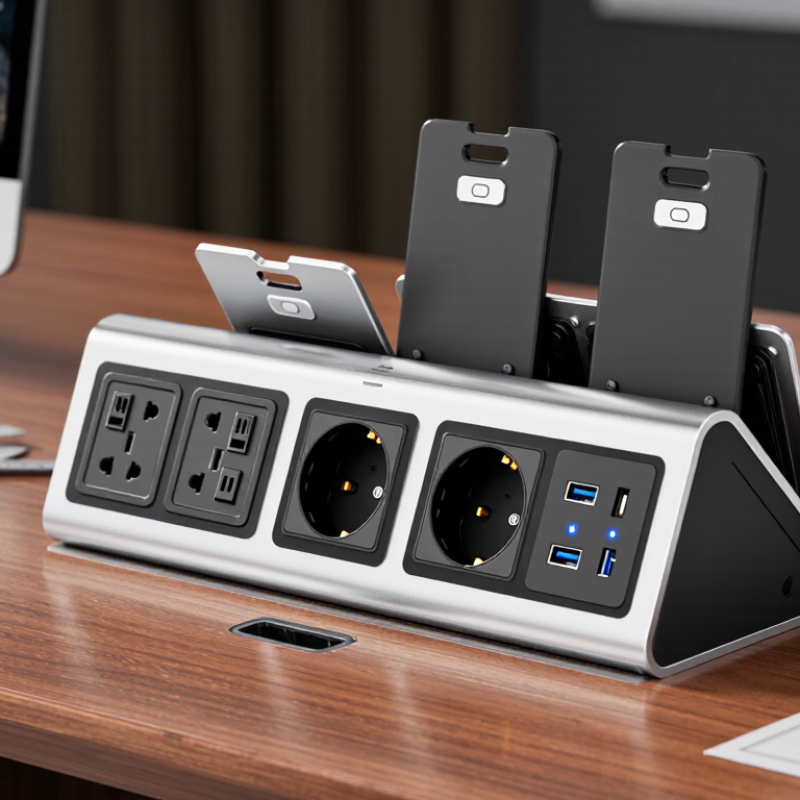
A pop-up socket is a retractable power and data unit installed inside a desk, island, conference table, or workbench. When closed, its lid sits nearly flush with the surface. Pressing a release mechanism lifts the housing. Some models rise manually, while others use spring-assisted movement. The upper module may hold power outlets, USB charging ports, network connections, or audio interfaces. Configuration varies by project.
Inside, insulated conductors connect the outlets to a protected supply cable. A grounded contact path helps direct fault current safely away from users. Depending on the design, an internal stop, latch, or damper controls movement. The enclosure shields wiring from accidental contact when the unit is open. Buyers should check load ratings, cable length, cutout dimensions, material thickness, and installation clearance before ordering. A socket can look compact but still require space beneath the panel.
In practical installation, accurate measuring matters more than attractive product photos. The cutout must be level, and the mounting frame should grip the panel without crushing it. I once underestimated underside clearance; the mechanism opened, but the cable bend felt strained. That small mistake deserved a redesign. For global purchasing, request drawings, test reports, sample units, and clear inspection criteria from the manufacturer. Ask how the unit handles repeated opening, dust, heat, and cleaning moisture. These details reveal engineering quality better than polished catalog language.
China’s pop-up socket manufacturers serve offices, kitchens, hotels, classrooms, and conference rooms. The main types include manual flip-up, motorized lift, desktop, floor-mounted, and recessed units. Manual models suit simple desks and lower budgets. Motorized units offer cleaner control, but they need reliable motors and stronger maintenance support. USB-A, USB-C, HDMI, network, and wireless charging options expand their usefulness.
Applications should guide the specification. A meeting table may need power, data, and display connections within one compact module. A kitchen island needs heat resistance, child protection, and easy cleaning. Floor units require stronger covers and suitable ingress protection.
Grand View Research valued the global smart home market at approximately USD 121.6 billion in 2023, showing continued demand for integrated electrical functions. The International Energy Agency also reports that buildings consume about 30% of global final energy, making efficient power management increasingly important.
Global buyers should inspect cutout dimensions, rated current, cable length, grounding, fire performance, and certification documents. Samples matter. A polished housing can still hide loose connectors or weak lifting mechanisms. This is where factory audits and repeated cycle testing become valuable.
UL, CE, RoHS, and other requirements vary by destination, so one certificate may not fit every market. The best sourcing decision is not always the cheapest quote. I have seen specifications become too ambitious, with extra ports reducing service life. Simpler designs can perform better.
Leading China Pop-Up Socket Manufacturers for Global Buyers
China’s leading pop-up socket manufacturers serve offices, kitchens, hotels, and shared workspaces. Their products combine power outlets, USB charging, and retractable designs. A reliable supplier should explain the internal structure clearly. Ask about spring durability, cable routing, panel thickness, and heat management. Small details matter.
In practical sourcing, samples reveal more than catalog photos. Test the lifting mechanism repeatedly. Check whether the cover closes smoothly after dust enters the opening. Inspect socket alignment and the finish around each edge. Request material declarations, electrical test reports, and production quality records. These documents should match the actual sample, not an older model. Confirm compatibility with the buyer’s destination voltage, plug format, and applicable safety requirements.
Factory communication also deserves careful review. Can the engineering team adjust cutout dimensions without weakening the housing? Can quality staff trace a batch from assembly to final inspection? No supplier is perfect. I once focused too heavily on appearance and missed a stiff cable channel. That issue could have caused installation delays. Clear drawings, pre-shipment inspection, and realistic lead times reduce such risks. Buyers should also discuss packaging strength, spare components, warranty handling, and response times before placing a large order. Reliability is built through evidence, not confident promises.
| Supplier Capability Category | Typical Product Range | Common Electrical Options | Common Protection Features | Relevant Compliance Considerations | Typical Application | Global Buyer Evaluation Points |
|---|---|---|---|---|---|---|
| Basic Manual Pop-up Socket | Retractable desktop socket with manual lift mechanism | Regional AC outlet formats; USB-A or USB-C may be available | Sliding cover, mechanical stop, concealed wiring when closed | Verify applicable national plug, wiring, grounding, and material requirements | Home offices, meeting rooms, study desks | Check cut-out dimensions, load rating, surface thickness, and replacement-part availability |
| Automatic Motorized Pop-up Socket | Electric retractable unit operated by a switch or touch control | AC outlets with integrated USB charging modules | Overload protection, soft-start movement, anti-pinch sensing on selected designs | Assess electrical safety, motor durability, EMC performance, and local certification needs | Executive desks, conference tables, premium workstations | Request cycle-life testing, noise data, standby consumption, and control-system details |
| Water-Resistant Pop-up Socket | Retractable socket designed for areas exposed to occasional spills | AC outlets, USB charging, and optional data connections | Sealing ring, drainage design, protective lid, moisture-resistant materials | Do not assume an IP rating; require test reports for the exact assembled model | Kitchens, hospitality counters, shared work surfaces | Confirm the tested IP level, installation orientation, drainage path, and cleaning resistance |
| Conference Table Connectivity Unit | Multi-port module for power, data, and audiovisual connectivity | AC power, USB-C charging, HDMI, network, and audio options | Cable management, thermal ventilation, replaceable modules | Verify separate requirements for mains power, USB charging, data, and audiovisual interfaces | Boardrooms, training rooms, coworking spaces | Evaluate port configuration, serviceability, cable routing, and compatibility with table thickness |
| High-Capacity Charging Pop-up Unit | Pop-up socket with USB-C Power Delivery charging | AC outlets plus USB-C PD and USB-A charging ports | Over-current, over-voltage, short-circuit, and over-temperature protection | Confirm the actual shared output, charging protocol, thermal test results, and regional approval | Commercial offices, hotels, education facilities | Compare continuous output rather than advertised peak output and verify connector quality |
| Custom OEM/ODM Pop-up Socket | Customized housing, outlet layout, finish, packaging, and interface selection | Configuration based on target market and project specification | Project-specific mechanical, electrical, thermal, and safety features | The final assembled product must be assessed for the destination market; component certificates alone may be insufficient | Furniture projects, contract interiors, property developments | Review drawings, tooling ownership, sample approval, quality-control plans, and change-control procedures |
Buyer note: Electrical ratings, plug compatibility, certification status, ingress protection, charging performance, and lead times vary by model and destination market. Always request model-specific technical documents and test reports before purchase.
For global buyers, a pop-up socket should be judged as an installed electrical product, not merely a polished desk accessory. I check contact stability, heat rise, grounding, shutter movement, and cable strain relief. A sample may look excellent. It can still fail after repeated lifting. Ask for test reports covering the exact model, materials, voltage, current rating, and final assembly.
Certification evidence needs careful reading. IEC 60884-1 is relevant to many household socket-outlets, but it does not automatically approve every customized design. Regional conformity marks should match the destination market and product configuration. The ISO Survey 2022 recorded more than 1.2 million ISO 9001 certificates worldwide, yet a certificate alone cannot prove electrical safety. Request the certificate scope, laboratory accreditation, test date, and factory quality records. Verify them independently where possible.
Customization should remain controlled. Buyers may specify aluminum or flame-retardant plastic housings, cable lengths, mounting depths, USB-C charging modules, or child-protection features. Each change can affect temperature, clearance, and durability. The IEA’s 2023 Global Status Report states that buildings use about 30% of global final energy and create roughly 26% of energy-related emissions. Efficient modules and low standby consumption therefore deserve attention. My imperfect rule is simple: approve the final configuration, not the prototype. A supplier resisting destructive testing is a warning sign.
This chart summarizes selected numeric reference requirements commonly used when evaluating pop-up socket assemblies against IEC 60884-1. Buyers should also verify applicable national approvals, CE or UKCA marking, RoHS and REACH documentation, factory quality systems, load testing, fire-retardant materials, and customization capability. The listed values are standard reference points, not company or brand performance data.
Sourcing, Pricing, and Export Considerations for International Buyers
Sourcing pop-up sockets in China requires more than comparing online quotations. Start by checking factory experience, production capacity, and quality-control records. Request samples with matching voltage, frequency, socket layout, and cable length. Test the lifting mechanism repeatedly. It should move smoothly without loose panels or sharp edges. Ask for material details, wiring diagrams, inspection procedures, and applicable safety certificates for your destination market.
Pricing usually depends on socket configuration, housing material, order quantity, packaging, and customization. A basic unit may look inexpensive, but tooling, sample charges, and export packaging can change the final cost. Request a detailed quotation with unit price, minimum order quantity, lead time, payment terms, and Incoterm. Compare landed cost, not only factory price. A low quote can still be a poor deal. Sometimes, the cheapest sample reveals inconsistent alignment or weak springs.
Export planning needs careful documentation. Confirm the correct HS classification with your customs broker. Check import duties, electrical requirements, labeling rules, and required conformity documents before production. Use reinforced cartons, moisture protection, and inner separators for long-distance shipping. Pre-shipment inspection should verify appearance, grounding, voltage performance, and carton quantity. I have seen buyers approve attractive samples, then receive different production details. Written specifications and batch photos reduce that risk, although they cannot replace independent inspection.
As a specialist in environmental and flow sensor technology, ScioSense enables companies to use the planet’s resources more sustainably, helping to create a healthier future for all.