How to Choose the Best Commercial Display Fridge

Choosing a Commercial Display Fridge is not just a matter of picking an attractive cabinet. The right unit must keep products at a suitable, consistent temperature while making them easy to see and reach. A fridge that looks impressive in a showroom may perform differently in a warm, busy shop. Details matter.

Start with what you plan to display. Bottled drinks, packaged desserts, and fresh sandwiches have different storage and presentation needs. Check the usable shelf space, temperature controls, and airflow design. A crowded cabinet can restrict circulation, so advertised capacity may not tell the whole story. Measure the installation area, including door clearance and access for delivery. Small oversight, big headache.

Visibility also deserves careful thought. Clear glazing, well-placed lighting, and adjustable shelves can help products stand out without making restocking difficult. Compare energy use and operating noise, too, especially if the fridge will run near customers or staff. Ask suppliers about warranty coverage, service availability, and cleaning requirements. These practical questions are easy to overlook when price dominates the decision.

This guide outlines how to compare key features, match a fridge to your products, and assess long-term running needs. Specifications offer a useful starting point, but real conditions matter. Check product details against your space, daily sales volume, and local operating environment. There may be no perfect model—only a better-informed choice.
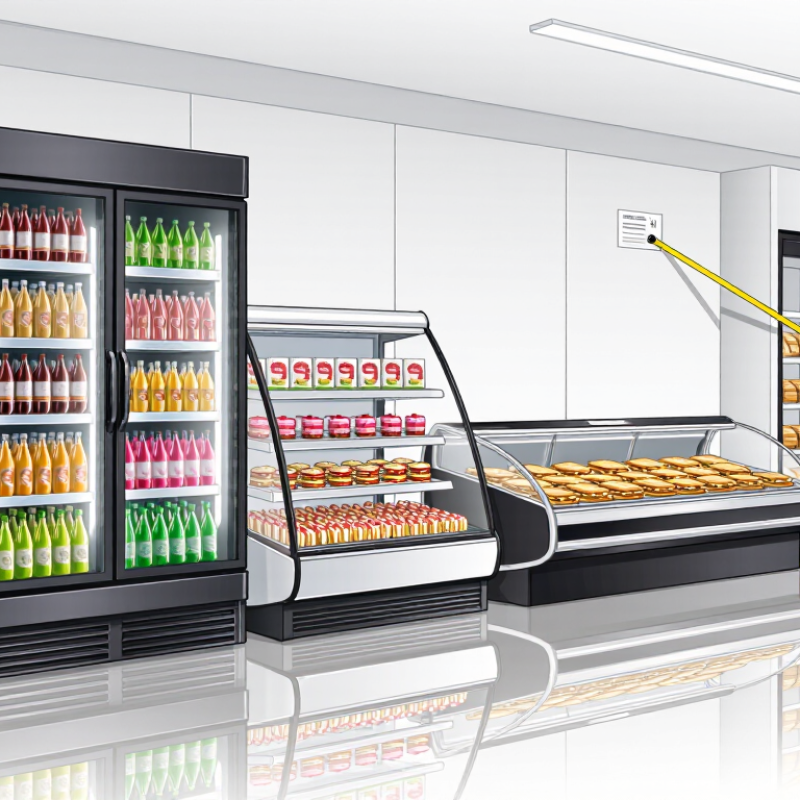
How to Choose the Best Commercial Display Fridge

Set Food-Safety Targets: FDA Food Code Limits Cold Holding to 41°F (5°C)

Choosing a commercial display fridge starts with a clear food-safety target. The FDA Food Code sets cold holding for time/temperature control for safety foods at 41°F (5°C) or below. Check local requirements too, since jurisdictions may adopt different code editions or rules. A glowing digital display is useful, but it does not prove that every item is cold enough.

Look for even cooling across shelves, a reliable temperature display, and quick recovery after the door opens. Busy service matters. Warm room air can rush in each time a customer reaches for a drink or a worker restocks cut fruit.

Avoid packing shelves tightly; blocked vents can leave warm pockets near the front or corners. Measure food with a calibrated probe, and use a separate thermometer to verify cabinet conditions. Check temperatures during busy periods, not only before opening.

A fridge may read 38°F while newly loaded food remains too warm. That detail is easy to miss.

Record readings and act when temperatures rise, following your food-safety procedures. Equipment helps control risk, but it cannot replace careful loading, cleaning, and monitoring.

Even experienced teams can overlook a door left ajar.

Match Cabinet Type and Capacity to Products, Shelf Loads, and Sales Volume

Choosing a commercial display fridge starts with the products, not the showroom. A drinks cabinet may need tall shelves and quick access, while chilled meals often need broad, stable surfaces. Measure the tallest package and the depth of trays before comparing cabinet types. Then check each shelf’s rated load; a shelf that looks sturdy may still be unsuitable for heavy bottles. Leave space around the cabinet for ventilation, too.

Capacity should reflect both stock and sales pace. Estimate the busiest period, then consider how often staff can refill the fridge. A high-volume store may benefit from more display space, but an oversized cabinet can waste floor area and energy when it stays half empty. That trade-off is easy to miss. Think about door openings, customer flow, and the distance to storage. I would recheck measurements on site, since plans rarely show every obstacle.

Tips: Group products by size and temperature needs. Sketch shelf positions using actual packages. Ask the supplier for load limits and usable capacity, not just exterior dimensions. Keep a little room for restocking. Not too much.

Verify Safety and Performance Against NSF/ANSI 7 Requirements

When choosing a commercial display fridge, verify its exact model against NSF/ANSI 7 requirements. Start with the model number, not just the product family. Check the manufacturer’s documentation and the certifier’s listing to confirm the unit is evaluated for commercial food storage. A broad “NSF compliant” statement may not cover every size, door, or configuration. Details matter.

Then assess how the fridge performs in your store. NSF/ANSI 7 addresses sanitation and temperature performance under specified test conditions, but your room may be warmer and busier. Ask for test information showing the unit can maintain suitable product temperatures in its intended environment. Consider airflow around shelves, frequent door openings, and how fully stocked displays affect cooling. Look for accessible, cleanable surfaces and drain details that fit your cleaning routine. Small things count. A spotless showroom model tells you little about a loaded case during a lunch rush. I would not rely on appearance alone, and I might still miss a detail on the first review. Compare the documentation with the exact unit being delivered, and confirm installation and operating limits before purchase.

How to Choose the Best Commercial Display Fridge - Verify Safety and Performance Against NSF/ANSI 7 Requirements

Use this checklist to compare commercial display refrigerators. Confirm compliance for the exact model and intended application; operating conditions and certification details can vary by equipment.

Evaluation Area What to Verify Practical Check Record or Decision
NSF/ANSI 7 certification Whether the exact model is certified or listed to the applicable edition of NSF/ANSI 7 for its intended use. Match the model identifier on the unit and product documentation to the certifier’s current listing. Check the scope and any use limitations. Model and listing verified: Yes / No
Intended application Whether the unit is designed for the specific use, such as packaged-food display, food storage, or another stated application. Compare the product listing, installation instructions, and manufacturer-stated use with the foods and service conditions at the site. Application matches: Yes / No
Food-contact and cleanability Whether food zones and exposed surfaces are suitable for their intended contact and can be accessed and cleaned as required. Review the listing and service manual; inspect seams, corners, shelves, drains, and other areas where soil or moisture could collect. Cleaning access acceptable: Yes / No
Temperature performance Whether the unit maintains the temperatures stated for its certified application and operating conditions. Review test or certification documentation and verify performance under the specified ambient conditions and loading instructions. Do not assume an empty-cabinet reading proves loaded performance. Required operating range documented: Yes / No
Cold-holding operation Whether the operating plan keeps time/temperature-controlled foods at the temperature required by the applicable food code. For U.S. Food Code applications, cold-held time/temperature control for safety food is generally maintained at 41°F (5°C) or below, subject to applicable code provisions. Check food temperature with a suitable thermometer. Food temperature meets local code: Yes / No
Temperature monitoring Whether the display, controls, and any alarms provide useful monitoring for the intended operation. Compare the cabinet display with a calibrated thermometer; check alarm operation and establish a routine for recording temperatures. Monitoring method and schedule documented
Loading and air circulation Whether shelves, product placement, and display layout allow the airflow required by the operating instructions. Check for blocked supply or return-air openings and follow stated loading limits. Avoid assuming that a packed display will perform like an unloaded one. Loading guidance available and followed: Yes / No
Installation conditions Whether site conditions meet the unit’s installation requirements, including ventilation, clearances, and ambient temperature limits. Compare the planned location with the installation manual, including required clearances and any restrictions on exposure to heat or direct sunlight. Site requirements satisfied: Yes / No
Electrical safety Whether electrical safety approval is documented separately from NSF/ANSI 7 sanitation and performance certification. Review the equipment nameplate and applicable electrical safety documentation; confirm the supply and installation comply with local electrical requirements. Electrical documentation checked: Yes / No
Maintenance and service Whether routine cleaning, condenser care, door or gasket inspection, and service access are practical. Review the maintenance schedule and confirm the unit can be serviced without obstructing required ventilation or food-handling areas. Maintenance plan in place: Yes / No
Final purchasing decision Whether certification, intended use, operating capacity, site conditions, and maintenance needs all match the operation. Resolve any mismatch before purchase; obtain written clarification for model-specific certification scope or performance claims. Suitable for this application: Yes / No
Important: NSF/ANSI 7 addresses commercial refrigerated food equipment; it is not a substitute for applicable food codes, electrical safety requirements, or local installation rules. The 41°F (5°C) cold-holding value above refers to the U.S. FDA Food Code baseline for time/temperature control for safety food, not a universal NSF/ANSI 7 rating for every display refrigerator.

Compare Energy Use: ENERGY STAR Commercial Units Can Use About 20% Less Energy

How to Choose the Best Commercial Display Fridge

Energy use can make a noticeable difference to a display fridge’s long-term running costs. ENERGY STAR commercial units can use about 20% less energy than comparable standard models, though actual savings depend on the product category and operating conditions. Check the unit’s verified energy data, not just its label, and compare models with similar capacity and temperature ranges. A larger cabinet may consume more electricity even when it is more efficient per cubic foot. Multiply the listed annual energy use by your local electricity rate to estimate operating costs.

Small details matter. A busy shop with frequent door openings may not see the same savings as a quieter setting. Inspect door seals, shelf layout, and airflow, then consider where the fridge will sit. Warm ovens, direct sunlight, or blocked vents can increase workload. Keep the condenser clean according to the manufacturer’s instructions, and avoid overloading shelves. These steps help maintain stable temperatures and reduce wasted energy. Energy ratings are useful, but they are not a promise of a specific bill. Choosing a unit that fits your products and daily traffic is a practical part of comparing efficiency.

Check Site Fit, Service Access, and Lifetime Operating Costs

How to Choose the Best Commercial Display Fridge

Check Site Fit, Service Access, and Lifetime Operating Costs

A display fridge may fit the sales floor but fail to pass through the stockroom door. Measure the delivery route, doorway width, ceiling height, and final position before ordering. Check the door swing and leave the ventilation clearance specified by the manufacturer. Measure twice. A few centimetres can decide whether staff can open the unit without blocking an aisle. Also consider where heat will escape; a cramped, warm corner can make cooling harder.

Service access matters long after installation. Make sure a technician can reach the condenser, filters, and electrical connection without moving shelving or closing the shop. Ask how routine cleaning is done and which parts need regular attention. Small details matter. For lifetime costs, compare estimated energy use in kilowatt-hours, then apply your local electricity rate. Include likely maintenance, replacement parts, and the cost of downtime. Frequent door openings and a hot sales area may raise actual consumption above a neat catalogue estimate. That estimate can still be useful, but it is not a promise. Record your assumptions, and revisit them after the fridge has run through a busy week.