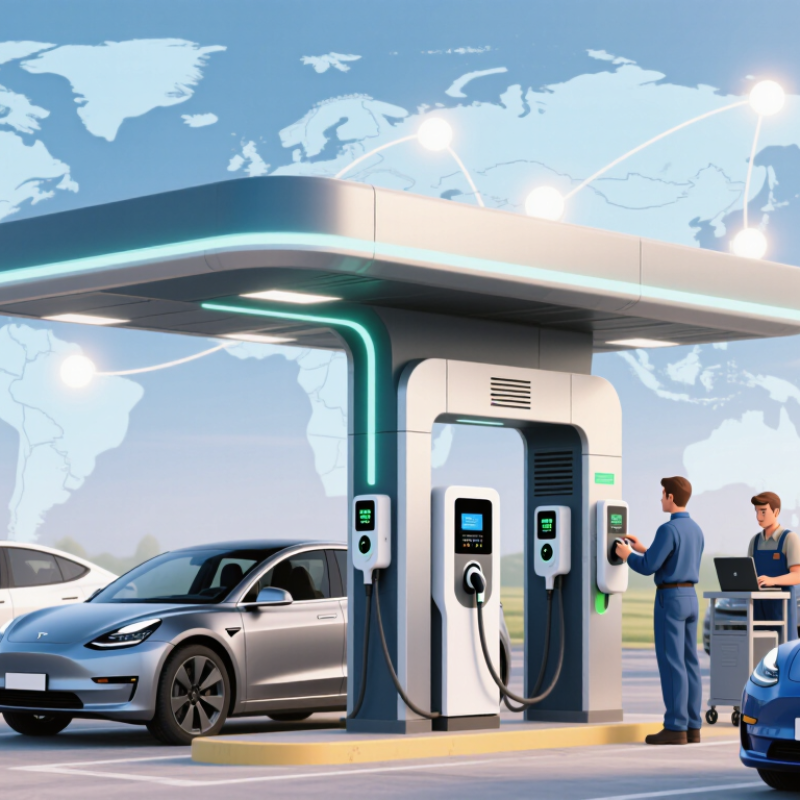
Choosing a Rapid Ev Charger for global markets requires more than comparing charging speed and purchase price. Buyers must examine vehicle compatibility, grid capacity, connector standards, climate conditions, software support, and local installation practices. A charger rated at 180 kW may perform far below its promise if the site has limited power or the vehicle accepts only 100 kW.
The details matter.
This guide introduces a practical method for evaluating chargers across different countries and commercial environments. It considers output power, charging efficiency, safety protections, enclosure ratings, payment systems, remote monitoring, maintenance access, and warranty coverage. Reliable manufacturers should provide test reports, clear technical data, installation instructions, and responsive service contacts. Independent certification and documented field performance also deserve careful attention.
Real sites reveal what brochures miss. Dust can block cooling paths. Winter temperatures can reduce charging speed. A crowded station may need cable management and stronger communication systems. Buyers should request installation references and ask how faults are handled after deployment. The cheapest option may create higher service costs later.
There is no perfect checklist.
Some specifications remain difficult to compare between suppliers, especially when testing conditions differ. That uncertainty should not be ignored. Global buyers should verify claims with local electricians, network operators, fleet managers, and qualified compliance specialists. A careful decision balances charging performance with long-term reliability, user safety, operating costs, and regional requirements. The right Rapid Ev Charger is not simply the fastest model; it is the one that performs consistently where it will actually operate.
Rapid charging usually means DC charging, not ordinary AC charging. AC chargers suit homes and workplaces, while DC chargers deliver power directly to the battery.
Many rapid units provide 50–150 kW. High-power models can exceed 300 kW, but vehicle limits and grid capacity still matter.
The IEA’s Global EV Outlook 2024 reported more than four million public charging points worldwide by the end of 2023. Over 1.3 million were added that year.
The market is expanding quickly, but compatibility remains uneven.
Global buyers should examine connector and communication standards carefully. CCS1 is common in North America, while CCS2 dominates much of Europe and other regions. GB/T is widely used in China, and CHAdeMO remains present in several markets. SAE J3400 is also becoming important in North America.
IEC 61851 supports charging control, while ISO 15118 enables advanced communication, including automated authentication.
A connector may fit physically but still fail electronically. That detail is easy to miss.
Tips:
Match charger voltage, current, and connector type with the target vehicle. Check local grid requirements before selecting a 240 kW system. Ask for test records covering temperature, payment systems, and emergency shutdowns.
The fastest charger is not always the best investment. A smaller unit may perform better at a weak site.
I have seen specifications look impressive, yet real charging times remained disappointing. Always compare field data with laboratory claims.
Choosing a rapid EV charger starts with the vehicle, not the advertised power. Check the vehicle’s maximum DC charging rate and connector standard. A 180 kW charger will not make a 100 kW vehicle charge faster. It may only increase equipment cost.
Site conditions matter just as much. Confirm available voltage, transformer capacity, cable distance, and local electrical requirements. A busy depot may need dynamic load management to prevent power peaks. Outdoor units also need strong weather protection, ventilation, and safe cable handling. In hot climates, charging performance can drop. This detail is often underestimated. A neat spreadsheet cannot replace a site survey.
Tips: Match charger power to real vehicle demand. Leave room for future vehicles, but avoid buying excess capacity today. Ask for efficiency data, operating temperature ranges, maintenance procedures, and independent safety testing. Test the charger with your actual vehicle mix before making a large purchase. Small compatibility issues can create long delays. Remember the grid connection may become the project’s slowest part. Planning documents are useful, but they are not always perfect. Recheck assumptions with a qualified local electrician and the utility provider. Reliable suppliers should provide clear technical drawings, warranty terms, spare-parts access, and response times. A lower purchase price can become expensive when installation, cooling, software integration, and downtime are included. Global buyers should also verify language support, payment systems, communications protocols, and regional certification requirements before shipment.
How to Choose a Rapid EV Charger for Global Buyers?
Global compatibility begins with the vehicle, not the charger cabinet. Check the connector type, charging voltage, current range, and communication protocol. A charger may fit physically but still fail during a real charging session. Confirm support for relevant standards, such as IEC 61851, IEC 62196, or ISO 15118, where applicable. Grid conditions also matter. A unit designed for one frequency or voltage may need different electrical equipment elsewhere.
Safety evidence should be specific and traceable. Look for protection against overcurrent, leakage, overheating, short circuits, and poor grounding. Residual-current protection is especially important in wet parking areas. Review the enclosure rating, emergency-stop design, cable temperature monitoring, and installation instructions. Ask for test reports from an accredited laboratory, not only a general compliance statement. Certification marks must match the destination market and the product’s exact model. A certificate for one configuration may not cover another.
Field experience often reveals gaps in paperwork. During commissioning, technicians should test several vehicles, inspect connector temperature, and record charging interruptions. Cold rain, dust, unstable voltage, and repeated use can expose weaknesses quickly. Software compatibility deserves equal attention. Remote monitoring, firmware updates, and payment systems may depend on local networks and data rules. I have found that supplier documents can look complete while omitting regional accessories. That is easy to miss. Buyers should request installation drawings, protection settings, spare-part availability, and a clear warranty process. Even then, no checklist catches everything. A controlled site test remains necessary before large-scale deployment.
| Evaluation Dimension | Verified Technical Requirement | Typical Global Reference | Evidence to Request | Buyer Decision |
|---|---|---|---|---|
| DC Charging Standard | The charger should support the DC communication and control requirements defined by IEC 61851-23 and the applicable vehicle charging protocol. | CCS is widely used in Europe and many other markets; GB/T is used in mainland China; CHAdeMO remains present in some installed fleets. | Connector specification, protocol list, vehicle compatibility matrix, and charging-session test records. | Select the connector standard required by the target vehicle population. |
| AC Input Compatibility | Confirm rated voltage, number of phases, frequency, maximum input current, short-circuit withstand capability, and earthing arrangement. | Common commercial supplies include 400 V three-phase at 50 Hz, but North American sites commonly use different voltage and frequency arrangements. | Electrical single-line diagram, input rating label, installation manual, and grid-connection requirements. | Do not purchase until the charger rating matches the local electrical supply. |
| Output Power and Site Capacity | Check continuous DC output power, output voltage range, maximum output current, and power-sharing behavior when multiple connectors operate simultaneously. | Typical rapid chargers range from approximately 50 kW to 350 kW; the vehicle and site supply may limit the actual charging power. | Rated-output curve, derating curve, load-sharing specification, and site load calculation. | Choose power according to vehicle battery voltage, dwell time, and available grid capacity. |
| Connector and Cable Design | Connector rating, cable length, liquid or air cooling, locking mechanism, and resistance to repeated insertion cycles must match the intended use. | High-current charging may require temperature monitoring and cable cooling to maintain safe operating limits. | Connector datasheet, current rating, thermal monitoring description, cable-management details, and cycle-test results. | Prioritize ergonomic handling and thermal protection for high-traffic locations. |
| Electrical Safety | The equipment should address overcurrent, overvoltage, undervoltage, short circuit, insulation failure, ground fault, emergency stop, and abnormal-temperature conditions. | IEC 61851-1 provides general conductive charging-system requirements; local electrical installation rules also apply. | Safety test reports, protective-device list, emergency-stop test record, and fault-response description. | Reject products without documented protection functions and test evidence. |
| Residual-Current Protection | The installation must provide suitable protection against AC residual current and smooth DC residual current, based on the charger design and local code. | IEC 62955 addresses residual direct current detection for certain EV charging applications; national rules determine the final protective arrangement. | Residual-current protection scheme, trip thresholds, type-test report, and installation instructions. | Verify compatibility between the charger’s internal protection and the site distribution board. |
| Ingress and Environmental Protection | The enclosure, charging connector, display, and cable should be rated for rain, dust, humidity, temperature variation, and UV exposure appropriate to the site. | IP54 or higher is commonly specified for outdoor equipment, but the required rating depends on the complete installation and local conditions. | IP test report, operating-temperature range, humidity specification, corrosion test information, and installation clearance requirements. | Use a higher environmental rating for coastal, dusty, snowy, or exposed locations. |
| EMC and Power Quality | The charger should control electromagnetic emissions and maintain immunity against disturbances. Harmonic current and power-factor performance may also affect grid approval. | IEC 61851-21-2 and relevant IEC 61000-series standards are commonly used as EMC references for conductive charging systems. | EMC test report, harmonic-current data, power-factor data, and utility interconnection approval where required. | Select equipment that will not interfere with nearby industrial, medical, or communication systems. |
| Regional Certification | Certification and marking must correspond to the country of installation, product category, voltage level, and applicable safety legislation. | Examples include CE for applicable European requirements, UKCA for applicable Great Britain requirements, and national certification schemes in other jurisdictions. | Declaration of conformity, certificate number, certification scope, accredited laboratory report, and marking photographs. | Confirm certification validity before shipment, customs clearance, and site commissioning. |
| North American Requirements | Products installed in the United States or Canada may require evaluation against applicable national electrical codes and recognized safety standards. | UL 2202 is a commonly referenced standard for electric vehicle charging system equipment; local authorities and utilities may impose additional requirements. | Nationally recognized testing certification, field-evaluation requirements if applicable, and installation-code compliance documents. | Use a certification path accepted by the authority having jurisdiction at the installation site. |
| Communication and Backend Integration | The charger should support reliable Ethernet, cellular, or Wi-Fi communication and an open charging-station protocol where network integration is required. | OCPP 1.6 JSON and OCPP 2.0.1 are widely used for charger-to-management-system communication, subject to feature compatibility. | Protocol version, API documentation, integration test results, remote-diagnostics functions, and offline-operation behavior. | Confirm that the charger can connect to the selected charging-management platform. |
| Cybersecurity and Access Control | Use encrypted communications, controlled administrator access, secure software updates, unique credentials, event logging, and a documented vulnerability-response process. | ISO/IEC 27001, IEC 62443, and ISO 15118-related security practices may be relevant depending on the network and charging features. | Security architecture, update policy, penetration-test summary, credential policy, and incident-response contact. | Treat network security as a purchasing requirement, not an optional software feature. |
| Payment and User Authentication | The selected payment method must comply with local payment, privacy, and consumer-protection requirements. | Possible methods include contactless payment, mobile applications, RFID authorization, QR-based access, or integration with a charging network. | Payment-terminal certification, supported currencies, transaction flow, refund procedure, and data-protection documentation. | Choose authentication methods that match local customer behavior and legal requirements. |
| Installation and Maintenance | Assess foundation requirements, cable routing, ventilation, service access, spare parts, technician training, and preventive-maintenance intervals. | High-power equipment may require dedicated switchgear, utility coordination, civil works, and periodic inspection. | Installation manual, commissioning checklist, service-level terms, spare-parts list, and maintenance schedule. | Compare total cost of ownership rather than purchase price alone. |
| Final Compliance Review | Confirm that the complete charger, accessories, installation, software, and operating process comply with the destination market’s requirements. | Compliance is determined by the complete installed system, not only by a single product certificate. | Country-specific compliance checklist, authority approval, commissioning report, and signed acceptance test. | Obtain written approval from the local electrical inspector, utility, or authority where required. |

Note: Certification, grid-connection, payment, and installation requirements vary by country and project type. Always verify the latest local regulations with the authority having jurisdiction before procurement.
How to Choose a Rapid EV Charger for Global Buyers?
Installation cost is more than the charger’s purchase price. A 150 kW unit may require transformer upgrades, thicker cables, concrete foundations, drainage, and protective equipment. Local permits and electrician rates can change the budget sharply. Check the grid connection before comparing quotations. A cheap charger can become expensive after civil work begins.
Operating costs depend on electricity tariffs, peak-demand charges, utilization, and energy losses. A busy highway site may recover its investment faster than a quiet office location. However, high utilization increases heat, connector wear, and cooling-system workload. Software fees and payment services also deserve attention. Ask for a clear five-year cost model, not only the first-year estimate. Numbers can still mislead.
Tips: Request installation drawings, warranty limits, spare-part prices, and local service response times. Confirm compatibility with regional voltage, communication protocols, and safety requirements. Keep space around the cabinet for ventilation and future repairs. A practical site walk can reveal hidden costs, such as weak pavement or insufficient cable routes. Maintenance planning is often underestimated. Filters, fans, connectors, and cooling fluids need regular inspection. Some buyers focus too heavily on charging speed and ignore downtime. That mistake is costly. Compare total ownership cost under realistic traffic conditions, then review the assumptions with an independent electrical professional.
Comparing installation, operating, and maintenance costs by charger power
Benchmark estimates are shown in USD thousands. Installation costs are one-time costs, while electricity and maintenance costs are annual estimates. Electricity is calculated using 2,500 equivalent full-load hours per year at an average commercial electricity rate of $0.12/kWh. Actual costs vary by grid connection, civil works, utilization, local tariffs, climate, and labor rates.
How to Choose a Rapid EV Charger for Global Buyers?
Global buyers should evaluate more than charging speed. The IEA’s Global EV Outlook 2024 reports nearly four million public charging points worldwide in 2023, a rise of about 40% from 2022. This growth increases pressure on charger uptime, software stability, and service response. A strong charger should support OCPP, remote diagnostics, dynamic load management, and secure payment functions. ISO 15118 readiness can also support future plug-and-charge applications. However, “smart” does not always mean dependable.
Reliability requires evidence, not attractive specifications. Request test records for high humidity, dust, freezing temperatures, and repeated cable use. Check the enclosure rating, cooling design, emergency controls, and expected operating temperature. Ask for a documented uptime target and maintenance process. The supplier should provide local spare parts, firmware updates, installation guidance, and trained technicians. The U.S. Department of Energy has repeatedly highlighted station availability and user access as key charging barriers. A fast charger that stays offline is still expensive equipment. This seems obvious, yet purchasing teams sometimes overlook it.
Tips: Test one unit before a large order. Measure real charging output, payment success, noise, and restart time. Ask who answers a service call at 2 a.m. Confirm warranty exclusions and response deadlines in writing. Supplier support can vary sharply between regions. I would also leave room for doubt: network integration may take longer than promised, especially with older vehicles and unstable sites. Use independent inspection reports, customer references, and a small pilot to verify every claim.
As a specialist in environmental and flow sensor technology, ScioSense enables companies to use the planet’s resources more sustainably, helping to create a healthier future for all.