
A Finger Scan Door Lock is more than a sleek panel beside an entrance. It must recognize a finger reliably, secure stored data, and work smoothly during everyday use. This guide to China’s top 10 manufacturers gives buyers a starting point for comparing suppliers, products, and capabilities. It does not treat a polished product page as proof of performance.
Security technologist Bruce Schneier has said, “Security is a process, not a product.” That principle matters here. A useful comparison should consider fingerprint recognition, backup access, installation requirements, app functions, warranty terms, and after-sales support. Ask how the lock responds to wet or worn fingerprints. Check whether the handle feels solid and whether the scanner works consistently in repeated trials. Small details count.
Still, specifications alone cannot settle every question. A manufacturer may offer strong features, yet provide limited documentation or unclear service arrangements. That deserves a closer look. Readers should verify claims directly and request current test records where available. The manufacturers discussed in this article are presented as candidates for research, not as a universal ranking for every home or project. Needs differ between a compact apartment door, a rental property, and a busy commercial entrance. The best choice is the one whose documented performance, support, and price match the actual use case. Some comparisons remain imperfect; supplier information changes, and not every feature is tested under the same conditions. That is worth remembering.
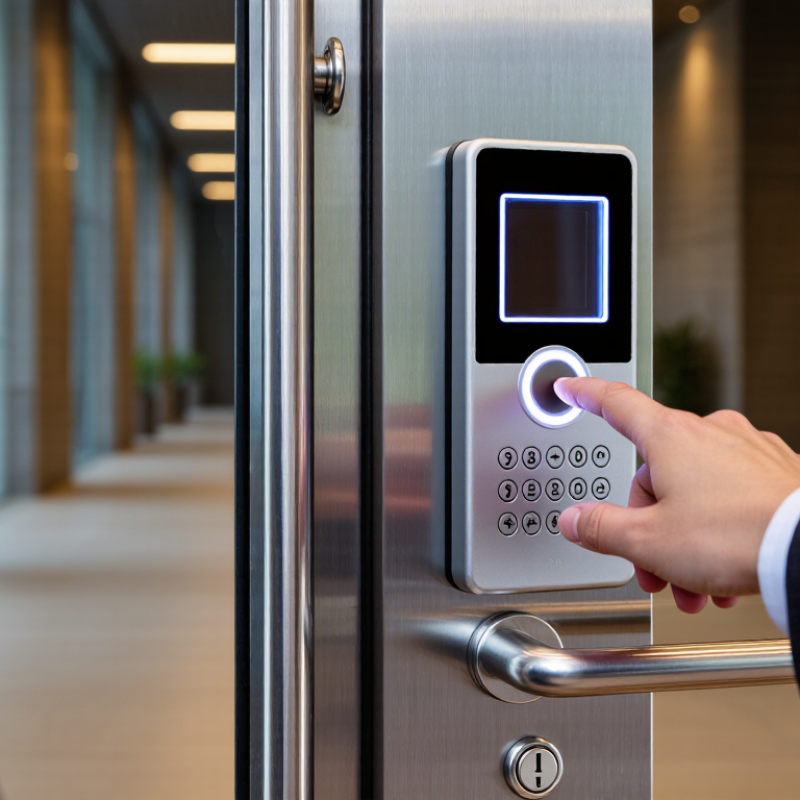
China Top 10 Finger Scan Door Lock Manufacturers
Understanding China’s Fingerprint Door Lock Industry
China’s fingerprint door-lock sector sits within a much larger smart-lock market. IDC’s China Smart Door Lock Market Quarterly Tracking Report estimated shipments at about 17.58 million units in 2023, up 3.8% year on year. This figure covers smart door locks broadly, not fingerprint-only models. That distinction matters when comparing supplier capacity or market claims. Dense component networks support rapid product development, but product quality can still vary.
When assessing a lock, look beyond the scanner’s appearance. Ask how it handles dry, worn, or slightly damp fingers. Inspect the latch, backup power access, and mechanical keyway. Request test records for repeated unlocking, temperature changes, and false-rejection rates. Check how fingerprint data is stored and whether firmware updates are documented. A polished demonstration proves little. Buyers may focus on recognition speed and overlook door thickness or installation tolerances. It is an easy mistake.
Tips: Compare equivalent models and confirm sensor type, test conditions, warranty scope, and sample configuration in writing. Request an independent laboratory report where available, and verify that it matches the quoted model. A spreadsheet helps, but it cannot replace checking a sample on the intended door.

Choosing a fingerprint door lock manufacturer takes more than comparing prices or scan speed. Grand View Research estimated the global smart lock market at USD 2.43 billion in 2023 and projected a 19.6% compound annual growth rate from 2024 to 2030. That growth signals rising demand, not consistent product quality. Ask suppliers for independent test reports showing false acceptance and rejection rates, and check whether tests covered dry, damp, worn, or dusty fingers. Real hands are not laboratory samples.
Inspect the lock itself. Request details on sensor type, fingerprint storage, encrypted communication, battery endurance, and what happens during power loss. Test sample units repeatedly with different users, then try them after washing and drying your hands. A fast demo proves little. Ask for mechanical-cycle results, production quality-control records, warranty terms, and replacement-part availability. Verify certificates against the requirements of your destination market rather than relying on a logo in a sales brochure.
Manufacturing experience matters, but evidence matters more. Request a factory audit or a live walkthrough of assembly and inspection steps. Compare the sample with units taken from regular production batches; variation can hide in the details. Some suppliers may not share every test record. That is worth noting, not automatically disqualifying. Document what remains unverified, and ask for a corrective-action process when defects appear.
Profiles of ten Chinese fingerprint door lock manufacturers can reveal more than product photos. Useful comparisons describe factory capabilities, design focus, and support after purchase. Some manufacturers may concentrate on apartment upgrades, while others serve larger residential projects. A profile should explain whether products use fingerprint, keypad, card, or mechanical-key access. Details matter. Buyers should also check how the lock handles failed scans, low batteries, and outdoor exposure.
Manufacturing claims need evidence. Look for clear specifications, sample testing options, and documented quality checks rather than broad promises. Ask about fingerprint sensor performance, compatible door thickness, installation instructions, and replacement parts. These details affect daily use. A polished catalog cannot show how a lock feels after months of repeated operation. Requesting samples and testing them on the intended door can expose fit or usability issues. Not every supplier will provide equally complete information, and that comparison is worth noting. Treat each profile as a starting point, then verify technical documents and service terms directly. A careful review is less exciting, perhaps, but more dependable.
China’s top ten finger scan door lock manufacturers are best compared by technology, product coverage, and repeatable production—not by feature lists alone. MarketsandMarkets’ Smart Lock Market report estimated the global market at USD 2.3 billion in 2023, projecting USD 5.3 billion by 2028, an 18.3% compound annual growth rate. This is market-wide data, not a fingerprint-lock shipment count, so it signals demand rather than proving any supplier’s performance. Demand is rising.
Technology separates products quickly. Capacitive sensors read fingerprint ridges through electrical differences; optical sensors capture an image and may be more affected by surface dirt or lighting. Compare dry-finger and damp-finger recognition, false-rejection handling, backup PIN or key access, and whether the lock works without cloud connectivity. Product ranges also matter: a factory may offer keypad, card, app, and fingerprint models, but broader catalogs do not guarantee better integration. Lab figures can flatter.
Manufacturing capability shows in less visible details: sensor calibration, lock-body tolerances, battery testing, firmware updates, and traceable quality checks. Ask for test methods and sample results, not only a stated production capacity. Check whether the same fingerprint module performs consistently across several units and after repeated use. One blind spot remains: public factory claims are difficult to compare without independent audits. I would hesitate to rank suppliers on advertised output alone.
Comparison framework: the entries below describe verifiable product and manufacturing criteria, not named companies, a verified ranking, or company-specific claims. Confirm each capability directly with the manufacturer.
| No. | Comparison Dimension | Relevant Technology or Product Range | What to Verify with the Manufacturer |
|---|---|---|---|
| 1 | Fingerprint sensing | Sensor type, scan area, recognition speed, and performance under different finger conditions vary by lock design. Capacitive sensors detect changes in electrical capacitance; optical sensors capture an image of the fingerprint. | Request sensor specifications and test results for dry, wet, worn, or aging fingerprints; confirm whether the sensor is integrated into the handle or mounted separately. |
| 2 | Fingerprint matching and spoof resistance | Matching algorithms compare captured fingerprint features with enrolled templates. Liveness-detection methods, when implemented, are intended to help distinguish a live finger from a presentation artifact. | Ask how enrollment and matching are performed, what liveness tests have been conducted, and which independent test reports support any security claims. |
| 3 | User capacity and credential management | Locks may support multiple fingerprint, PIN, or card credentials. User limits and administrator functions depend on the model and its firmware. | Check the exact capacity per credential type, how credentials are added or revoked, and whether audit records are available and retained locally or in an app. |
| 4 | Access methods and product range | Common options include fingerprint, PIN code, mechanical key, and contactless card; some models also support mobile credentials. Available combinations are model-specific. | Request a model-by-model credential matrix and confirm that included cards, keys, apps, and functions match the intended market and use case. |
| 5 | Lock and door compatibility | Product formats can include deadbolts, mortise locks, and retrofit or rim-style locks. Backset, door thickness, handing, and cylinder requirements differ across installations. | Obtain dimensional drawings and installation requirements; verify compatibility with the target door, existing lock preparation, and local building requirements. |
| 6 | Connectivity and smart-home integration | Depending on the model, connectivity may use Bluetooth, Wi-Fi, or a separate gateway. Remote access and third-party integration are not inherent features of every fingerprint lock. | Confirm supported protocols, gateway requirements, app availability by region, firmware-update policy, and whether key functions work without an internet connection. |
| 7 | Power and low-battery operation | Battery type and operating life depend on battery capacity, lock usage, radio activity, and environmental conditions. Many electronic locks provide a low-battery warning; backup power arrangements vary. | Ask for battery specifications and test assumptions, warning behavior, emergency power options, and the procedure for entry when batteries are depleted. |
| 8 | Mechanical override and fail-safe planning | Some electronic locks provide a mechanical key override or an external emergency-power contact. The presence and design of these features vary by product. | Confirm the override method, key management, emergency access procedure, and how the lock behaves during power loss or electronic failure. |
| 9 | Environmental and durability testing | Temperature, humidity, corrosion, ingress protection, and cycle-life performance depend on product construction and the tests performed. An IP rating applies only to the tested configuration and conditions. | Request test methods, reports, rating scope, and applicable certifications; check that they cover the exact model and intended installation environment. |
| 10 | Manufacturing and quality-control capability | Relevant evidence may include documented incoming-material checks, assembly controls, functional testing, traceability, change management, and final inspection. Capacity and processes must be established for each supplier. | Verify factory audit records, quality-system certificates and their scope, production capacity, sampling or 100% test procedures, defect handling, and batch traceability. |
China Top 10 Finger Scan Door Lock Manufacturers
Key Factors in Choosing a Chinese Door Lock Supplier
Choosing a Chinese supplier takes more than comparing unit prices. MarketsandMarkets’ 2023 Smart Lock Market report estimated the global market at US$2.3 billion in 2023, with a forecast of US$4.4 billion by 2028. That growth makes supplier quality and production capacity especially important. But a larger market does not guarantee a dependable product.
Ask for documented fingerprint recognition results, including the test conditions and reported false acceptance and rejection rates. Request samples from regular production, not only a polished showroom unit. Test them with dry and slightly damp fingers, then check response time, keypad clarity, and what happens when batteries run low. Small details matter. Ask how the supplier tracks defects, checks incoming components, and handles firmware updates. An audit or independent test report can help verify claims.
Confirm lead times, minimum order quantities, packaging options, and access to replacement parts in writing. Ask who responds when a lock fails after installation, and how quickly they can provide technical guidance. A supplier’s answers should be specific, not just reassuring. A neat sample can still hide an inconsistent process, and buyers can overlook this while focusing on price. No supplier is perfect; transparent records and practical after-sales support make problems easier to manage.
When evaluating a door-lock supplier, ask for test evidence for the exact model and its stated IP rating. Under IEC 60529, the second digit describes protection against water: IPX4 covers splashing, IPX5 water jets, IPX6 powerful water jets, and IPX7 temporary immersion. These code numbers are classifications, not percentages; an IPX7 rating alone does not confirm IPX5 or IPX6 jet resistance.
As a specialist in environmental and flow sensor technology, ScioSense enables companies to use the planet’s resources more sustainably, helping to create a healthier future for all.