
China Best Cordless LED Desk Light Supplier is more than a search phrase. It points to a practical buying decision involving battery safety, optical performance, materials, and supplier reliability. A strong Cordless Led Desk Light should illuminate a notebook evenly without creating harsh reflections on glossy paper. It should also remain stable on a narrow bedside table or a crowded study desk.
Dr. Mariana Figueiro, a respected lighting researcher, has stated, “Light is the most powerful synchronizer of the human circadian system.” Her observation reminds buyers that brightness alone is not enough. Color temperature, glare control, and daily usage patterns deserve attention. During supplier evaluations, experienced buyers often inspect battery cycle records, charging protection, LED color consistency, and measured flicker performance. They may also review production samples under ordinary room lighting, not only polished showroom conditions. Small details matter.
A dependable China Best Cordless LED Desk Light Supplier should provide clear specifications, realistic runtime data, material information, and responsive technical support. Certifications and test reports should be verified for the intended market. Yet no product is perfect. Runtime can change with brightness, battery age, and temperature. A lamp that feels excellent in a factory sample may need adjustment after mass production. That uncertainty deserves honest communication. Careful sourcing combines factory experience, independent testing, and thoughtful user feedback. The best supplier is not simply the cheapest option. It is the partner that explains limitations clearly and keeps improving the product.
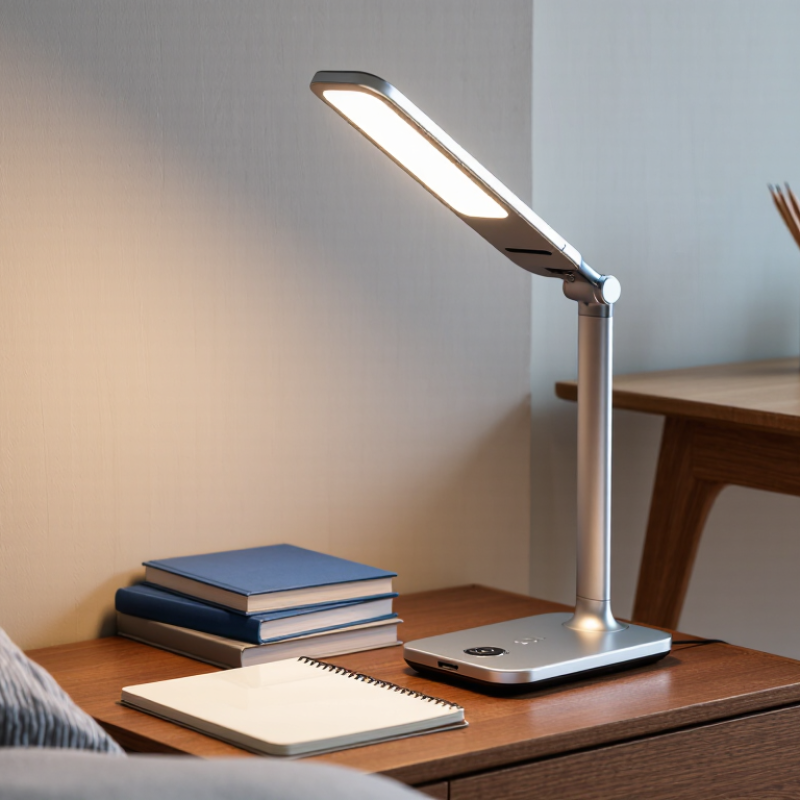
A cordless LED desk light combines flexible placement with focused, efficient illumination. The U.S. Department of Energy reports that LED lighting uses at least 75% less energy than incandescent lighting and can last up to 25 times longer. For daily desk work, look for adjustable brightness, stable light output, and a diffuser that reduces harsh glare. A color temperature between 3,000K and 4,000K usually suits reading, writing, and computer tasks. A CRI of 80 or higher supports more natural color rendering. Details matter.
Battery performance needs careful checking. A stated 12-hour runtime may apply only to the lowest brightness setting. At full output, practical use can be much shorter. Battery claims vary. Reliable product testing should record runtime at several brightness levels, charging time, and heat around the battery housing. Testing methods aligned with IEC 60598-1 and photometric measurement practices can improve comparison quality. The International Energy Agency continues to identify efficient lighting as an important energy-saving opportunity, while The Global E-waste Monitor 2024 reported 62 million tonnes of electronic waste generated in 2022. Therefore, a responsible cordless light should support replaceable components where practical, durable charging ports, and recyclable packaging. This is where product pages often overpromise. A careful supplier should provide measured data, not optimistic estimates.

China Best Cordless LED Desk Light Supplier
Choosing a China-based LED desk light supplier can shorten the path from product idea to stable production. Many factories support rechargeable batteries, touch controls, dimming, and adjustable color temperature in one design. This matters when a desk lamp must fit a small study, shared office, or hotel reading table. An experienced supplier can review beam angle, battery capacity, charging time, and heat control before mass production. Small details matter.
China’s manufacturing network also supports practical customization. A supplier may adjust the arm length, base weight, light output, packaging, or charging port to match your market. Direct factory communication can reduce unnecessary layers and clarify technical changes faster. Samples, pilot orders, and inspection reports provide useful evidence before larger commitments. Ask for test records, material specifications, and clear production milestones. Do not rely on attractive photos alone.
Cost is another benefit, but the lowest quotation is not always the safest choice. A cheaper battery or weak hinge may create returns later. The process is not flawless. Color consistency can shift, and delivery dates may move during busy seasons. Reliable suppliers explain these risks instead of hiding them. They should also provide product documentation suited to applicable safety and electrical requirements. Regular video inspections and independent quality checks can strengthen trust, although they add time and expense. That trade-off is easy to underestimate.
| Evaluation Dimension | Typical Data or Industry Range | Key Benefit of a China-Based Supplier | Buyer Verification Points |
|---|---|---|---|
| Product Customization | Common options include color temperature, brightness levels, lamp finish, battery capacity, charging port, packaging, and logo placement. | Access to established electronics, lighting, metalworking, plastic, battery, and packaging supply chains supports integrated customization. | Request drawings, approved samples, material specifications, and a written change-control process. |
| LED Efficacy | Approximately 80–120 lumens per watt is a practical range for many general-purpose LED desk-light designs; actual system efficacy depends on optics and driver losses. | A broad component-sourcing ecosystem can help buyers compare LED, driver, and optical configurations for energy-efficient designs. | Verify measured lumens, input power, test conditions, and the complete lamp efficacy rather than LED-chip claims alone. |
| Color Temperature | Warm-to-neutral white products commonly cover approximately 2700–4000 K; tunable products may extend to about 6500 K. | Suppliers can often provide multiple CCT configurations for residential, hospitality, office, and study applications. | Confirm CCT tolerance, color consistency, and whether the stated range applies to the full product or only the LED component. |
| Color Rendering | CRI 80+ is widely used for general lighting; CRI 90+ is preferred where more accurate color appearance is required. | Different LED packages and phosphor options can be evaluated according to the target market and application. | Ask for CRI test reports, including R9 where color-critical performance matters. |
| Brightness Control | Typical cordless desk lights offer 3–5 brightness levels or continuous dimming, depending on the control design. | A mature electronics supply base supports touch controls, buttons, rotary controls, memory functions, and stepless dimming. | Test flicker, dimming stability, control sensitivity, and brightness memory after power-off. |
| Battery Configuration | Rechargeable cordless models commonly use a single lithium-ion cell with a nominal voltage of about 3.7 V; capacity varies by product size and runtime target. | Battery, protection-board, charger, and enclosure suppliers can be coordinated within one manufacturing region. | Check cell type, rated capacity, protection functions, charging temperature limits, and transport documentation. |
| Operating Runtime | Many portable desk-light designs are specified for several hours of use per charge; runtime changes significantly with brightness and battery capacity. | Suppliers can balance battery size, lamp weight, brightness, and charging time for a defined use case. | Measure runtime at each brightness level and require a defined end-of-discharge voltage. |
| Charging Interface | USB-based charging is common; 5 V input is widely used for compact consumer lighting products. | Multiple cable, connector, adapter, and charging-board configurations can be matched to different regional requirements. | Confirm connector durability, charging current, overcharge protection, and adapter compatibility. |
| Quality-Control Process | A standard process may include incoming-material inspection, assembly checks, charging tests, illumination tests, aging tests, and final sampling inspection. | Factory and third-party inspection services are widely available for pre-production, in-process, and pre-shipment checks. | Define acceptance criteria, sampling level, defect classification, and inspection responsibility in the purchase contract. |
| Compliance Documentation | Depending on the destination market, documentation may include electrical safety, electromagnetic compatibility, restricted-substance, battery, and transport records. | Suppliers can coordinate testing and documentation with qualified laboratories for the intended sales region. | Check certificate validity, model-number consistency, test-standard versions, and whether reports cover the final configuration. |
| Production Lead Time | Lead time varies by tooling, component availability, customization level, order quantity, and production schedule; sample and mass-production timelines should be agreed separately. | Established component clusters can shorten coordination time when the supplier manages multiple production processes. | Obtain a milestone schedule covering sample approval, material procurement, production, inspection, and shipment. |
| Packaging Development | Options may include retail boxes, protective inserts, multilingual manuals, barcode labels, and shipping cartons. | Packaging design, printing, and assembly can often be coordinated with the product manufacturing process. | Verify drop protection, carton dimensions, packaging materials, labeling requirements, and compression performance. |
| Total Cost Evaluation | The landed cost includes product price, tooling, testing, packaging, inland transport, freight, insurance, duties, taxes, and inspection fees. | Direct sourcing can provide more opportunities to compare specifications, production arrangements, and shipment terms before placing an order. | Compare quotations using identical specifications and Incoterms, and calculate total landed cost rather than unit price alone. |
Note: The ranges and specifications above are general industry reference values. Actual performance, compliance, pricing, minimum order quantity, and lead time depend on the final product design, destination market, order volume, and supplier quality system.
A reliable cordless LED desk light begins with carefully selected materials. Common housings use flame-retardant ABS or durable polycarbonate, while aluminum helps release heat around the LED board. The battery should include stable cells, protected charging, and traceable batch records. Small parts matter. Loose hinges or weak charging ports can damage user confidence quickly.
A capable China supplier should control production through documented procedures, not visual inspection alone. ISO 9001-based systems can support consistent purchasing, assembly, and recordkeeping. Product design should consider applicable safety and electromagnetic requirements for each target market. Testing may include insulation checks, charging protection, light stability, color temperature, color rendering, and thermal performance. Samples should also undergo repeated hinge movement and battery cycle testing.
Quality control works best at several stages. Incoming inspectors check plastic color, aluminum thickness, LED bins, connectors, and battery voltage. During assembly, workers verify wiring, torque, charging indicators, and diffuser placement. Finished units need aging tests, drop checks, switch testing, and lumen measurements. Keep clear reports. They reveal patterns that appearance can hide. No factory is perfect. A supplier that records failures honestly can improve faster than one that only shows polished samples. Buyers should review test methods, calibration dates, corrective actions, and pre-shipment inspection results before selecting the best cordless LED desk light supplier.
Customization should begin with use, not decoration. For a cordless LED desk light, discuss brightness levels, color temperature, battery capacity, charging ports, and body materials. A reliable supplier can adjust the lamp head, base size, switch position, and light diffusion. These details affect comfort during reading, studying, and video calls. Ask for a working sample before approving large production. Small changes often appear only during daily use.
Certifications support trust, but documents need careful checking. Request current test reports, factory quality records, and certificates required in your target market. Confirm that the reports match the exact model, battery, adapter, and production version.
Private label service may include logo printing, color boxes, instruction manuals, barcodes, and product photography. Packaging should protect the lamp without creating unnecessary waste. Clear communication reduces costly misunderstandings. Still, the first sample may not be perfect. Review it honestly.
Tips: Prepare a detailed specification sheet. Include logo size, packaging dimensions, battery information, and inspection standards. Ask about minimum order quantities and lead times. Keep written approval records. A pre-shipment inspection can catch loose switches, uneven light, or charging problems. Test several units, not just one. That extra step matters.
Choosing a China-based cordless LED desk light supplier requires more than comparing unit prices. The U.S. Department of Energy reports that LED lighting can use at least 75% less energy and last up to 25 times longer than incandescent lighting. Ask suppliers to provide measured brightness, color temperature, battery capacity, charging time, and tested lifetime. Request laboratory reports, not only product catalog claims.
Check the supplier’s manufacturing experience through factory audits, production photos, and recent sample records. A reliable supplier should explain LED binning, heat management, battery protection, and quality-control checkpoints. Confirm whether each sample matches mass production. Small details matter, such as a loose charging port or a dimming wheel that feels rough. It can affect returns.
Review compliance documents for the destination market, including electrical safety and battery transport requirements. The International Energy Agency states that lighting represents about 15% of global electricity consumption, so efficiency claims deserve careful verification. Compare delivered lumens, not just LED wattage. A 2024 sample may perform differently after repeated charging. Test at least 50 charging cycles before approval, although this is still not a full durability study. I would not trust a supplier that refuses independent testing. Price matters, but an unusually low quotation may hide weaker cells, thinner materials, or unstable color output. The evaluation process is imperfect; even a polished factory visit cannot replace long-term inspection data.
As a specialist in environmental and flow sensor technology, ScioSense enables companies to use the planet’s resources more sustainably, helping to create a healthier future for all.